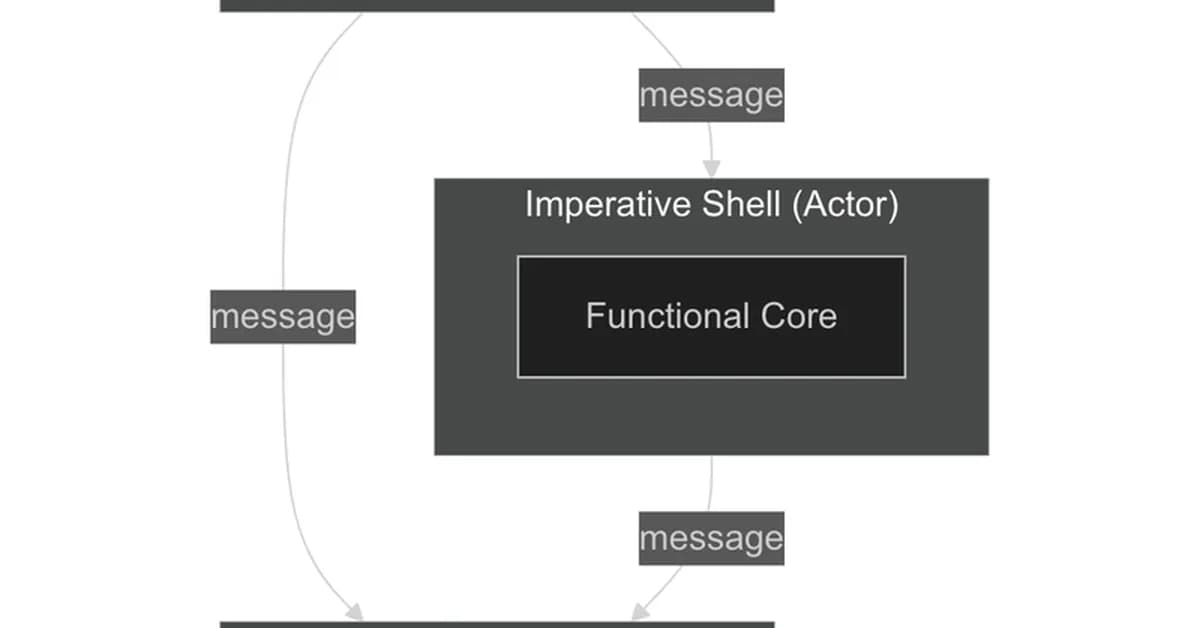
The article discusses the application of the "functional core – imperative shell" pattern in a modular and scalable architecture, particularly within an actor-based system. This approach aims to bridge traditional object-oriented programming (OOP) with functional programming paradigms while maintaining clear boundaries between different components.
Key Concepts
- Functional Core: The pure functions that perform the main logic of your application without side effects.
- Imperative Shell: The code responsible for handling side effects, such as input/output operations, state management, and interaction with external systems.
Modular Design Using Actors
The article introduces a design where each actor is an instance of the core-shell pattern:
- Core: Pure functions that process data and produce new states.
- Shell: Handles communication (e.g., message passing), side effects, and integrates the pure functions into the larger system.
Example: Input Handling and Game Logic
Consider two actors in a game application:
-
InputActor:
- Core: Pure function that processes input events to determine player actions.
- Shell: Handles receiving input events from external sources (e.g., keyboard, controller) and publishes messages representing player actions.
-
GameEngineActor:
Read the full article at DEV Community
Want to create content about this topic? Use Nemati AI tools to generate articles, social posts, and more.
2
Tags
Contents

Ali NematiWritten by Ali
![[AINews] The Unreasonable Effectiveness of Closing the Loop](/_next/image?url=https%3A%2F%2Fmedia.nemati.ai%2Fmedia%2Fblog%2Fimages%2Farticles%2F600e22851bc7453b.webp&w=3840&q=75)