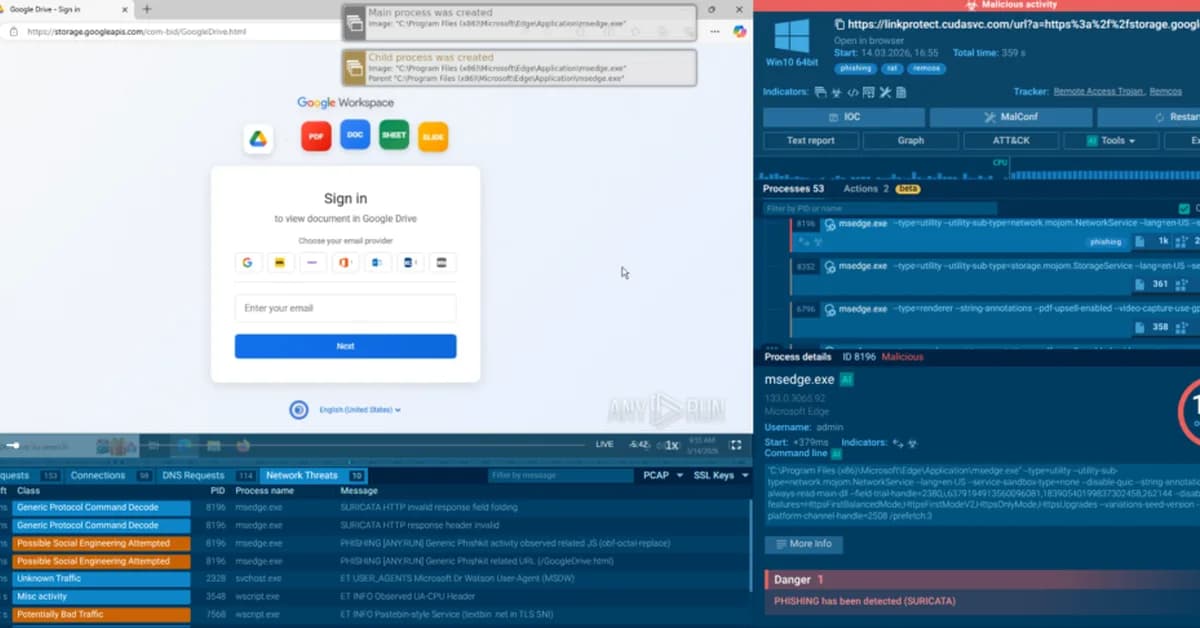
The document discusses a sophisticated phishing campaign that leverages Google Cloud Storage to deliver the Remcos Remote Access Trojan (RAT). This attack highlights the challenges faced by traditional cybersecurity measures in detecting and responding to threats that abuse legitimate services. Here's a summary of key points:
Overview of the Phishing Campaign
- Abuse of Legitimate Services: The campaign uses Google Cloud Storage as a trusted domain, making it difficult for conventional security tools to flag suspicious activities.
- Remcos RAT Delivery: Once initiated, the attack deploys Remcos via process hollowing techniques, using legitimate Microsoft processes (RegSvcs.exe) to evade detection.
Challenges in Detection
- Extended Mean Time to Detect (MTTD): Traditional security measures often fail to detect such attacks due to their reliance on known-bad lists and static analysis.
- Behavioral Analysis Required: The attack requires a deeper understanding of the behavioral patterns post-execution, which traditional tools may not provide.
Proactive Protection with ANY.RUN's Enterprise Suite
ANY.RUN offers several modules designed to address these challenges:
Triage & Response: Interactive Sandbox
- Interactive Analysis Environment: Allows analysts to manually interact with suspicious files and URLs in a sandboxed environment
Read the full article at Malware Analysis, News and Indicators - Latest topics
Want to create content about this topic? Use Nemati AI tools to generate articles, social posts, and more.
262
Contents

Ali NematiWritten by Ali