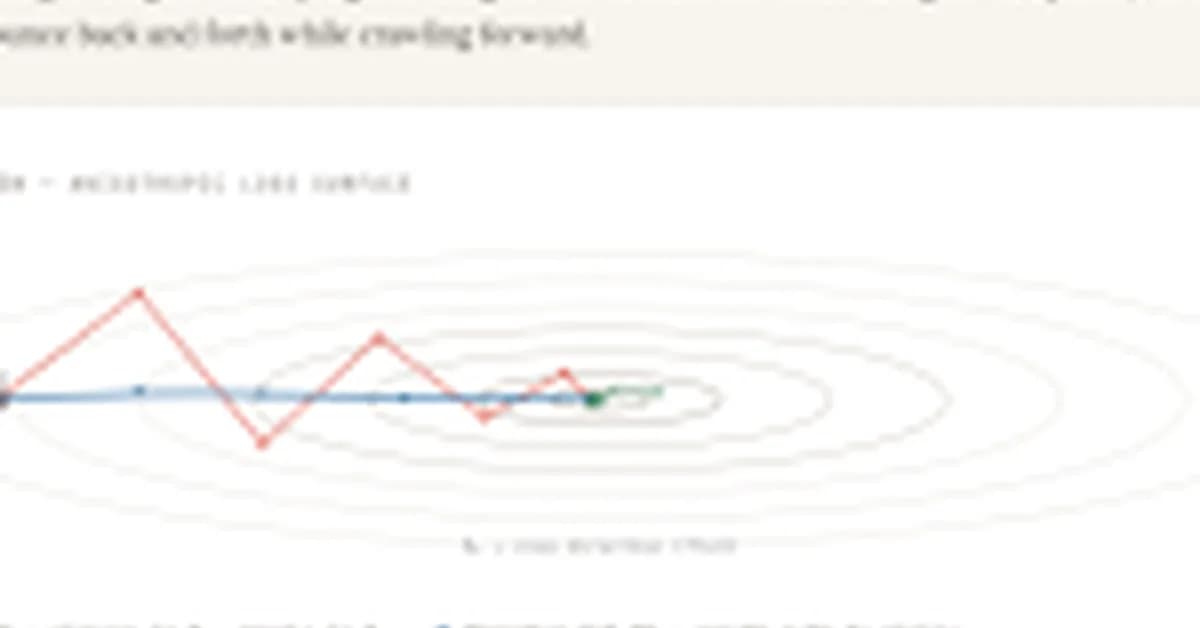
The experiment you described illustrates the sensitivity of the momentum parameter (β) in gradient descent optimization algorithms. Here's a summary of key findings and insights:
Key Findings:
-
Convergence Improvement with Increasing β:
- As β increases from 0 to around 0.95, the number of steps required for convergence decreases significantly.
- This improvement is due to better smoothing of oscillations along the slow direction (θ₁) and accumulation of useful momentum in the fast direction (θ₂).
-
Deterioration Beyond Optimal β:
- When β exceeds 0.95, particularly around 0.99, convergence performance deteriorates sharply.
- High values of β lead to excessive reliance on past gradients, causing overshooting and instability.
-
Baseline Comparison (β = 0):
- At β = 0, the optimizer behaves like vanilla gradient descent with no momentum effect.
- This serves as a reference point for comparing the benefits and drawbacks of different β values.
Insights:
- Role of Momentum:
- Momentum helps in smoothing out oscillations along the slow direction (θ₁) by canceling them out over time.
Read the full article at MarkTechPost
Want to create content about this topic? Use Nemati AI tools to generate articles, social posts, and more.
5
Tags
Contents

Ali NematiWritten by Ali
![[AINews] The Unreasonable Effectiveness of Closing the Loop](/_next/image?url=https%3A%2F%2Fmedia.nemati.ai%2Fmedia%2Fblog%2Fimages%2Farticles%2F600e22851bc7453b.webp&w=3840&q=75)