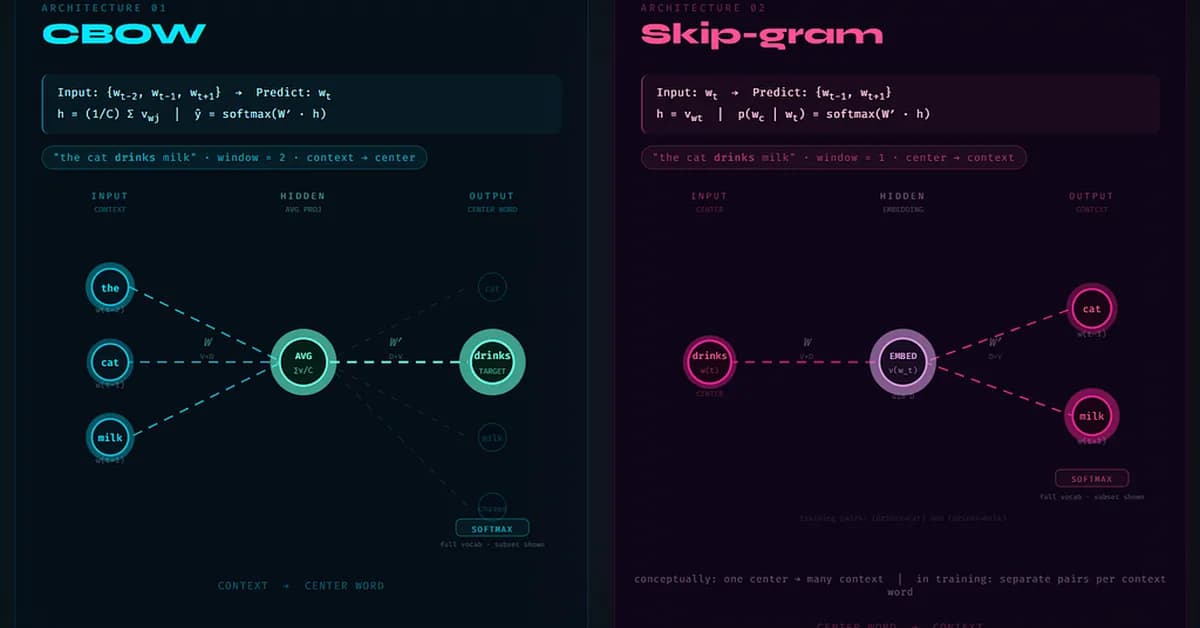
After the training phase in Word2Vec, the model's primary purpose shifts from generating predictions for context words during training to providing pre-trained vector representations of individual words. These vectors capture semantic and syntactic relationships between words based on their contexts within the training corpus.
Here’s a detailed breakdown of how inference works:
1. Pre-Trained Embeddings
- After training, the first weight matrix (input-to-hidden) contains learned word embeddings for each word in the vocabulary.
- Each row of this matrix represents an embedding vector for a specific word.
2. Querying Word Vectors
- During inference, users typically query these pre-trained vectors rather than generating text.
- For example, if you want to get the vector representation of "cat", you simply look up its corresponding row in the first weight matrix.
3. Similarity and Analogy Tasks
- Word2Vec embeddings are often used for tasks like word similarity and analogy questions.
- Word Similarity: Measure cosine similarity between vectors to find words that have similar meanings or contexts.
python 1from sklearn.metrics.pairwise import cosine_similarity
2
3cat_vector = model.wv['cat']
4dog
- Word Similarity: Measure cosine similarity between vectors to find words that have similar meanings or contexts.
Read the full article at Towards AI - Medium
Want to create content about this topic? Use Nemati AI tools to generate articles, social posts, and more.
4
Tags
Contents

Ali NematiWritten by Ali
![[AINews] The Unreasonable Effectiveness of Closing the Loop](/_next/image?url=https%3A%2F%2Fmedia.nemati.ai%2Fmedia%2Fblog%2Fimages%2Farticles%2F600e22851bc7453b.webp&w=3840&q=75)