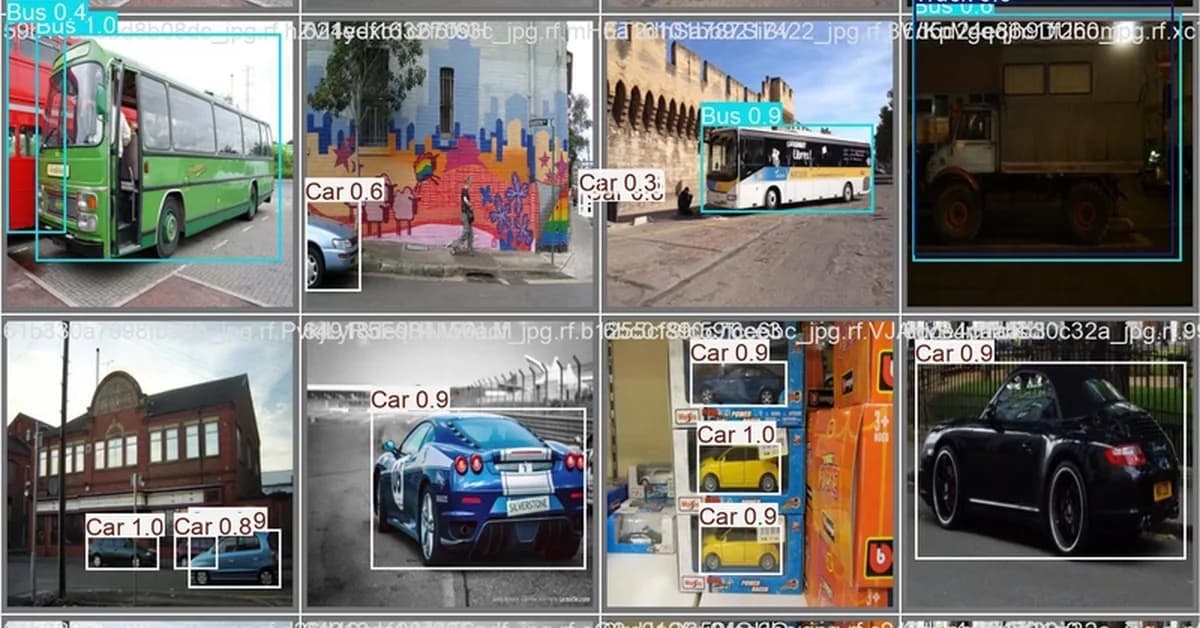
The latency paradox in the context of fine-tuning deep learning models like YOLO (You Only Look Once) refers to the often unexpected improvement or stability in inference speed when a model undergoes domain-specific training. This phenomenon is particularly interesting because it contrasts with the common perception that adding more layers, parameters, or complexity generally slows down inference times.
Key Observations:
-
Inference Time Reduction:
- After fine-tuning on the Cars Detection Dataset, several models (e.g., YOLOv11 and YOLOv26) showed a significant reduction in inference time.
- For example, YOLOv11's original inference time was 5.67 ms/image, which dropped to 4.47 ms/image after fine-tuning—a decrease of 1.20 ms/image.
- Similarly, YOLOv26 saw a more substantial reduction from 8.20 ms/image to 5.07 ms/image, a decrease of 3.13 ms/image.
- After fine-tuning on the Cars Detection Dataset, several models (e.g., YOLOv11 and YOLOv26) showed a significant reduction in inference time.
-
Stability in Inference Time:
- Some models (e.g., YOLOv5 and YOLOv12) showed minimal
Read the full article at DEV Community
Want to create content about this topic? Use Nemati AI tools to generate articles, social posts, and more.
2
Contents

Ali NematiWritten by Ali
![[AINews] The Unreasonable Effectiveness of Closing the Loop](/_next/image?url=https%3A%2F%2Fmedia.nemati.ai%2Fmedia%2Fblog%2Fimages%2Farticles%2F600e22851bc7453b.webp&w=3840&q=75)