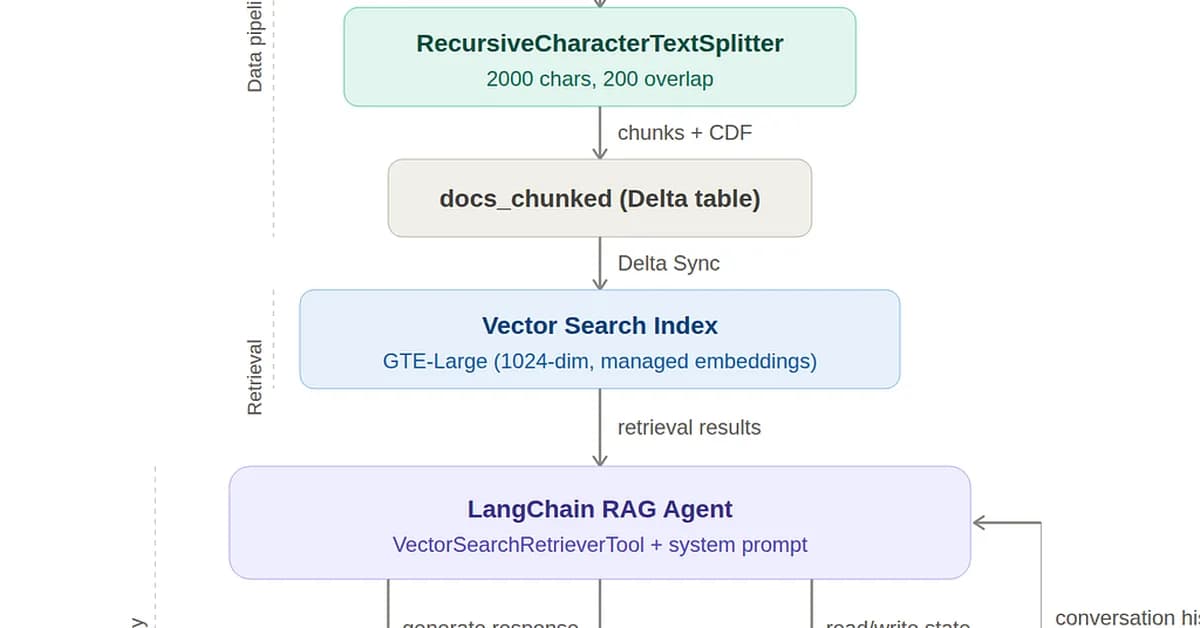
The result of deploying a LangChain-based knowledge assistant with memory persistence using Databricks' Lakehouse features is impressive. Here's a summary and some key takeaways from your implementation:
Summary
You've successfully created an intelligent, multi-turn conversational agent that leverages:
- LangChain: A framework for building agents that can interact in natural language.
- Databricks Vector Search: To retrieve relevant information from a knowledge base.
- Lakehouse Architecture: Specifically using Databricks' Unity Catalog and Lakehouse features to store and manage data efficiently.
- Lakehouse Autoscaling (Lakebase): For dynamically scaling the database based on load, ensuring cost-effectiveness.
Key Takeaways
-
Multi-Turn Conversations:
- The agent can now handle multi-turn conversations where context from previous turns is remembered.
- This is achieved by passing a
thread_idthat uniquely identifies each conversation session across multiple API calls.
-
Contextual Understanding:
- By persisting the conversation history in Lakebase, the agent can understand references to previously mentioned entities (e.g., "it" resolving correctly to "Orion").
- This significantly improves user experience and the perceived intelligence
Read the full article at Towards AI - Medium
Want to create content about this topic? Use Nemati AI tools to generate articles, social posts, and more.
Views282
On this page

Ali NematiBlogUI.author_articles