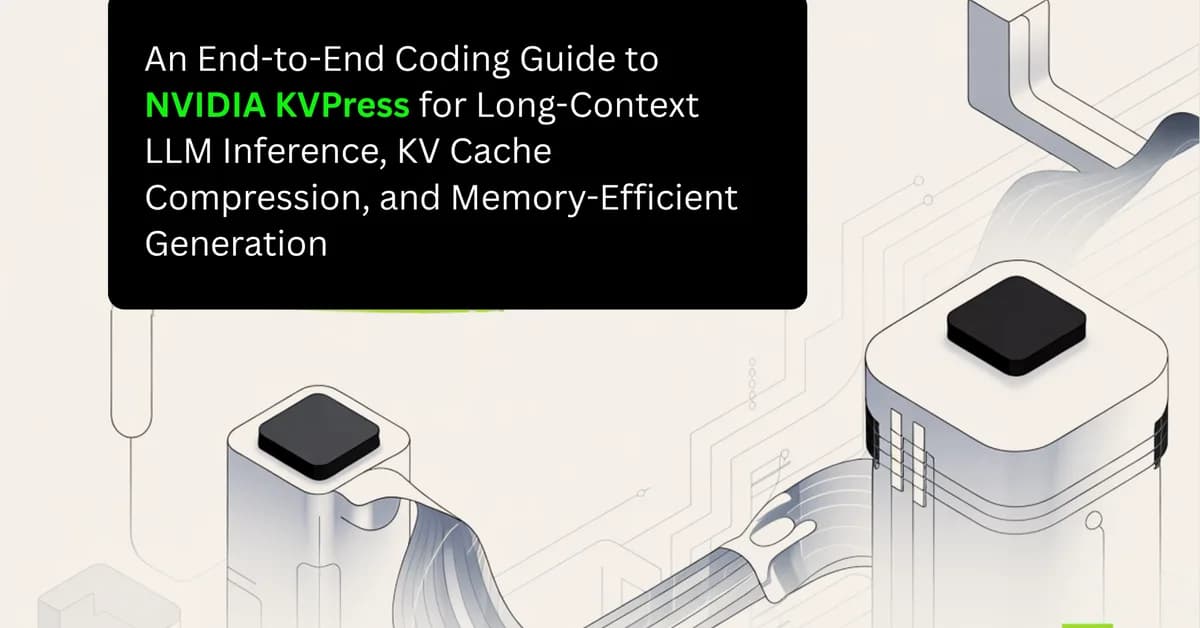
The post titled "An End-to-End Coding Guide to NVIDIA KVPress for Long-Context LLM Inference, KV Cache Compression, and Memory-Efficient Generation" provides a comprehensive tutorial on using NVIDIA's KVPress framework. The guide aims at optimizing large language model (LLM) inference when dealing with long contexts by applying key-value cache compression techniques. Here are the main points covered in this tutorial:
Key Points of the Tutorial
-
Introduction to NVLink and KVCache Compression:
- Explanation of how NVIDIA's technology, specifically NVLink, enables efficient communication between GPUs.
- Introduction to KVCache (Key-Value Cache) and its role in reducing memory usage during inference for long-context LLMs.
-
Setting Up the Environment:
- Instructions on installing necessary Python packages such as
transformers,torch, andkvpress. - Loading a pre-trained model from Hugging Face's Model Hub using NVIDIA’s optimized versions of these models.
- Instructions on installing necessary Python packages such as
-
Building the Context:
- Constructing a synthetic long context by combining multiple records or documents to simulate real-world scenarios where LLMs need to process extensive text data.
-
**Running Inference Ex
Read the full article at MarkTechPost
Want to create content about this topic? Use Nemati AI tools to generate articles, social posts, and more.
143
Contents

Ali NematiWritten by Ali